


Legal Basis and Statutory Authority
The Reserve Bank of Zimbabwe (RBZ) derives its powers to oversee, supervise and operate payment systems primarily from the Reserve Bank of Zimbabwe Act [Chapter 22:15] and the National Payment Systems Act [Chapter 24:23].
Read in Conjunction with the Following Statutes
- Banking Act [Chapter 24:20]
- Bills of Exchange Act [Chapter 14:02]
- Bank Use Promotion and the Suppression of Money Laundering Act [Chapter 24:24]
- Exchange Control Act [Chapter 22:05]
The NPS Act empowers the Reserve Bank to monitor and regulate payment system activities to ensure compliance, financial stability, and the smooth operation of payment, clearing and settlement systems. In addition, the Central Bank is guided by international best practices and standards.
International Standards and Best Practices
The Central Bank adopted the Bank for International Settlements (BIS) Committee on Payment and Market Infrastructures (CPMI) Principles for Financial Market Infrastructures (PFMIs) in 2013.
The PFMIs were issued in April 2012 by CPMI in collaboration with the International Organization of Securities Commissions (IOSCO) and replaced earlier international standards governing payment, clearing and securities settlement systems.
Five Central Bank Responsibilities
- A: Regulate, supervise and oversee Financial Market Infrastructures (FMIs)
- B: Ensure adequate powers and resources for oversight
- C: Disclose oversight policies relating to FMIs
- D: Apply the PFMIs
- E: Cooperate with other authorities
24 Principles for Financial Market Infrastructures (PFMIs)
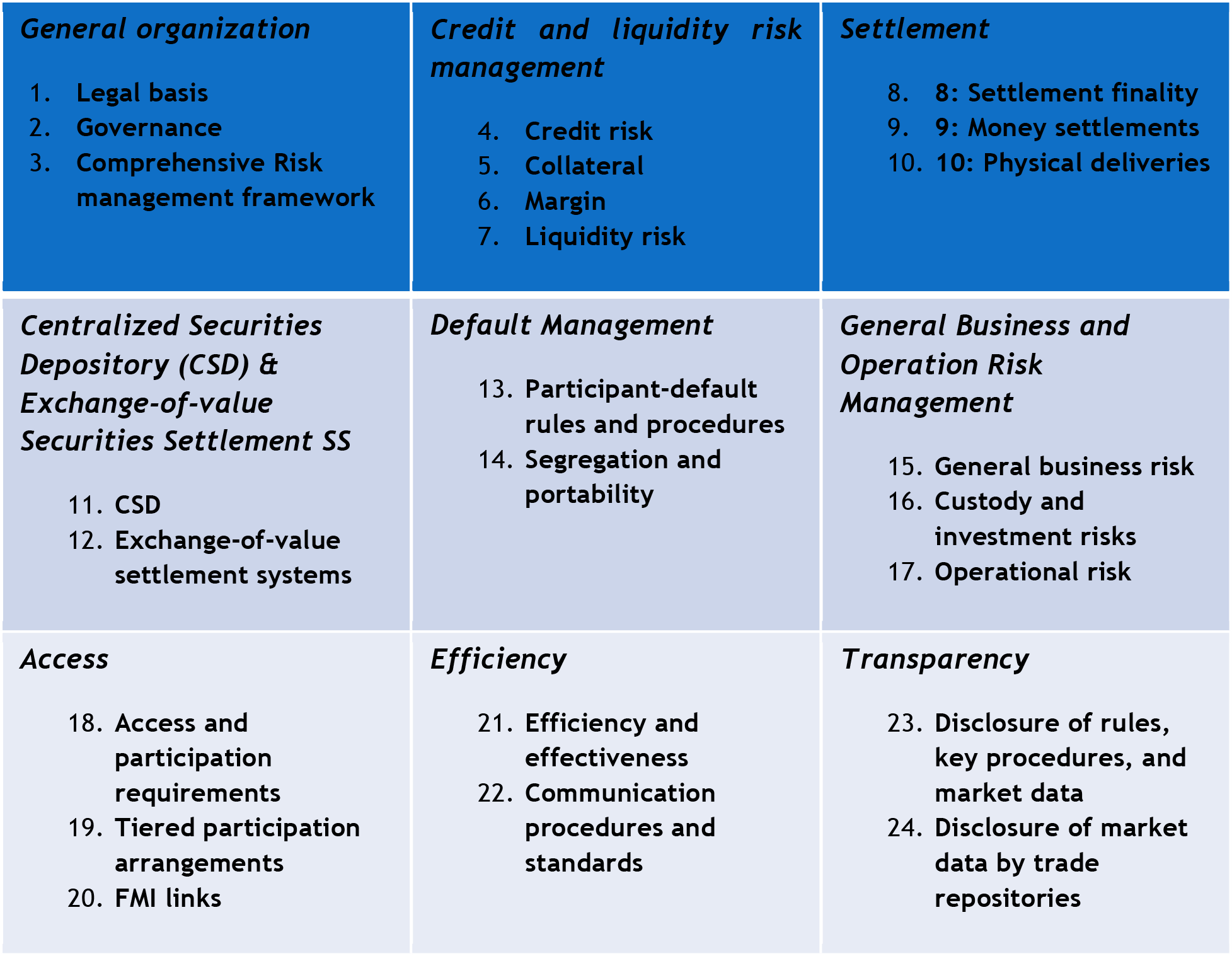
General organisation of the 24 Principles for Financial Market Infrastructures (PFMIs).